From this point on, I don't think I will be putting anymore posts on this blog.
Instead, I will post future book reviews (among other things) on my new blogsite: lilyychoi.wordpress.com.
Yeah, I just wanted to move to Wordpress.
That blog has also been in existence for a while, but I recently felt the need to consolidate the stuff here with the stuff over there. That other blog, which is called "Scraps and Scribbles," includes not just book reviews, but also book recommendations, Christian devotional posts, and other kinds of topics that I have always wanted to blog about.
Thank you to everyone who visited my page in the past few years, and I hope you come check out my new blog too :)
Saturday, March 14, 2015

Thursday, December 25, 2014
Daughter of Heaven
Daughter of Heaven
by Nigel Cawthorne
The historical biography of Empress Wu Chao, who rose to power towards the beginning of the Tang dynasty and left a legacy for women and Emperors after her. The story of her life is something worth admiring - sure, she was pretty ruthless, and had a tendency to kill off her own relatives and/or lovers, and liked to build uselessly large temples venerating her as a goddess, but she also became a ruling regeant in an age when any political power was off-limits for women, made a lot of nice changes to the civil service examination systems and such, and paved the way for her succeeding Emperors to bring the Tang dynasty to its glory days. The last chapter or two of the book is dedicated to exploring what happened after Wu Chao died, and it gives a good idea of the kind of legacy she left her successors. Women in the palace, one after another, entered the court and bid for power in the same fashion as Wu Chao had done, and the idea that women were helpless little kitchen maids took a backseat in the decades following Wu Chao's abdication and death. This is amazing, considering the Confucious ideas that dominated Chinese historical thought. Plus the number of coup de tats was astounding - Wu Chao really shook things up in court before she left it for good.
Cawthorne has done an amazing amount of research into Wu Chao's history, and draws from a variety of sources in order to bring out the most complete picture of what was going on at the time. He often brings in extraneous information about the culture of palace life, or records of small episodes that don't hold much weight in the grand scheme of politics, just to provide a more comprehensive look at what life was like in the Chinese palace at the time. Some of it feels useless, but others definitely add an interesting perspective. For instance, when describing Wu Chao's early entrance into the palace as a concubine, Cawthorne spends an almost obnoxiously long amount of pages giving details about sex life in the palace - this feels pretty useless considering the book is more about Wu Chao's political contributions and intrigues. However, later on Cawthorne narrates small vignettes that occurred between ministers and Wu Chao (e.g. a minister speaks out bravely against Wu Chao's promiscuous private life, and contrary to everyone's expectations that the queen would shout "OFF WITH HIS HEAD!!" she bestows a reward on him for his honesty) to flesh out the figures that inhabited her palace.
The narrative voice tends to get a bit dull and repetitive - Cawthorne is more of a historian than a writer. He does a fairly good job of giving an objective, foreigner's look at this highly charged historic and political figure, and leaves it up to the reader to judge Wu Chao based on her promiscuous love affairs, her violent rise to power, or her helpful reforms that did much to improve China's socio-economic situation. However, he tends to use the same adjectives and narrative phrasing one too many times and often uses plainly awkward sentence structures. There are also some grammar mistakes - not frequent, but enough to get annoying after a while. This is probably more the fault of the editor than the author himself, but it still shows a lack of attention (or a lack of grammatical skill) to the work as a published document.
Be prepared to memorize names. Lots of them. Foreign, Chinese names that have been desperately romanized and cannot be pronounced in any form of English without some tongue-twisting. The author was kind enough to include a "Dramatis Personae" at the end of the book cataloging the names of everyone who appears, but who wants to be going back and forth looking up names at every sentence? I just chugged through it. It sometimes makes it easier because most of the characters end up dying within a few pages of being introduced.
Overall a nice introduction to some Chinese history. It was a pretty basic volume of information, but I liked that it was very elementary level reading because I had to be reading a lot of more advanced, difficult books at the same time for school.
Thursday, November 6, 2014
Midsummer Night's Dream
A Midsummer Night's Dream
by William Shakespeare
Is this a classic?
Yes.
Does it deserve to be?
Yes.
I will be the first to admit that I didn't get around to actually reading this thing until taking my upper div class: Early Shakespeare plays. But that doesn't mean it wasn't good! On the contrary, if I didn't have to move on to Hamlet in the next week (and more plays after that), I'd want to read through it again because it sure holds a lot of delicious monologues and startling questions for me to ponder.
Having read this with approximately 80 fellow students in the English department, I'd say the biggest turn-off of this book is the plot.
...Not to say the plot is bad. Only that it comes off as slightly confusing.
Ok, maybe a bit more than slight. That love rectangle between Lysander, Hermia, Helena, and Demetre can send any Korean Drama junkie on a run for her money, just because it's so hard to keep track of! At least in Korean Dramas and soap operas, the protagonists love the same person the whole time (disclaimer: this generalization does not apply to certain dramas with indecisive love interests). Here, Lysander and Demetre switch back and forth between the two women more than once. It does not help at all that Hermia and Helena have extremely similar names!
But drawing out multiple relationship charts for yourself will solve this problem. Do not let the confusion of hearing two men spout two different sets of romantic confessions turn you away, because this play really can get you thinking about the fundamental nature of love.
As most are aware, in this story the love potion of the little love flower plays a vital role. In a word, it creates a love disaster. Ironically enough, the mischievous fairy Puck uses this same flower to resolve the problems in initially caused, ultimately rounding out the play with a happy ending. It may be easy to move on at this point, nodding amicably at the nice resolution with 4 happy couples celebrating their love in the last scene. Yet the question of the love potion still remains - especially because Demetre remains under the spell at the end of the story. "What, so he's cursed to be in love with Helena forever, under a magical love potion?" some may ask.
I myself expressed doubts at the prospect of marrying someone he may not even love, but I realized that the question runs even deeper than this. What if Demetre's love for Helena isn't a lie? Sure, he's under a love potion spell, but he thinks he really loves Helena. He himself (and everyone else, especially Helena) is happy with their marriage. Then who are we, as outsiders, to question their feelings for each other.
Besides, his initial love for Hermia wasn't very convincingly justified either. Why in the world did Demetre love Hermia? The play never tells us. He never tells us. He simply feels himself in love, and acts upon it. Then how is that any different from the love induced by an outside source?
Following this train of thought brings the readers into a messy territory, where love remains undefined and the nature of the relationship between man and woman is challenged. The fact that the play never even attempts to answer this question amuses and inspires me all the more. If people wonder how scholars find so much to write about in a Shakespeare play (volumes upon volumes of literary criticism!), here's a tiny little sliver of an answer to that question.
The question of love definitely remains ongoing and unsolvable, but trying out brains at it through fictional romantic comedies like Midsummer Night's Dream always proves a worthwhile challenge.
Wednesday, June 18, 2014
Firstborn
Firstborn: A Novel
by Lorie Ann Grover
I . . . what?
I feel that I'm usually a pretty generous reader. Books that have been published generally pass a certain standard of "good," but this time I really wanted to question the publishers behind this novel. When I first picked it up, the story appeared interesting: a desert fantasy setting, about a girl born among an oppressed people, who must live as a boy. But as I read on, the downward spiral began...
As a reader and a lover of all written works, I found very little in this book to redeem itself.
First off, the back-story has much to be desired. What is this world? What kind of society is it? What are the social structures, and how do the two major religions play a role in it? Though these questions are addressed in the book, they are never fully explored; at least, not enough to immerse me into the world that she is creating. This is a brand new world here, with new countries, customs, people, cultures....it seems too half-baked for me to invest my interest into it.
Same goes for the characters. There just isn't enough of them. There are a standard amount of characters, by number, but none of them are fully fleshed out. Even the main character, who is speaking in first-person, fails to draw upon my empathy. This may be because her emotional reactions to the situation around her doesn't seem to match up (she frequently gets overly upset or extremely happy in response to things that wouldn't draw out such emotions. Either that, or the author does a poor job building up the drama towards that moment), or because I am not given enough information about her from the start. I don't feel like I got to really know who she is as a person, even though I journeyed through almost 300 pages with her.
And the geographic description is, well, hazy. I don't expect penmenship on par with Tolkien's Lord of the Rings, which is notorious for its detailed description of the landscape of his world in the first book of the trilogy. What I do wish to see is a place I can imagine, even if it's not 100% accurate according to what the author is imagining. Instead, I get something like:
"My glance skitters over the open vista. Beyond the rocky desert and the distant humped dunes are other lands." -pg. 59, Chapter 13, "The Trek"
I realize that books these days try to keep bare descriptions short to keep the reader engaged, but here the description is so brief that I don't have time to picture it before I need to move on.
Also, the sentences are a bit...short. Not that I have anything against short sentences. Many fantastic books have been written with short sentences. But the imperial tone of the narration, and the setting of the story, makes it sound incompatible when the entire book consists of sentences that don't go past two lines. In a book that casually throws around phrases like "For certain" and "Our subservience to you" and "I still my centerself," I think the author can afford to use a comma or two in her sentences. In short, I felt awkward reading it, because I felt that the author felt awkward writing it.
And lastly, the ending. The ending that left many, many knots unfinished, and resolved maybe two problems out of the many other ones the author laid out for us. And one of those resolved issues was only introduced in chapter 80, five chapters before the end. The gist of it is that she runs away from her community, but that seriously doesn't solve any of her problems. I don't even think there's a sequel for this, so not sure how she'll survive on her own in a new country that hasn't even been introduced throughout the book's entirety...
The idea of the plot itself was intriguing. But the execution was poor, at least in this reader's opinion. I have seen many reviews on Bookreads and Amazon that rate this book positively, but sad to say, I can't agree with them. Hopefully my next Christian fantasy novel has more to offer.
Friday, June 6, 2014
The Karamazov Brothers
The Karamazov Brothers
by Fyodor Dostoevsky
"Two extremes . . . remember that a Karamazov can encompass two extremes, and both at one and the same time!" -Ippolit Kyrillovich, in his prosecution speech during Mitya's trial
First off, this book is not thought-provoking. It does a lot more than just provoke. It's a book that smashes your preconceived, half-baked conceptions of good, evil, free will, and happiness . . . it'll smash them to smithereens, and then maybe, perhaps, will give you a solution on how to rebuild the shattered pieces into a whole again.
Dostoevsky does this not through the plot or the storyline, but through his presentation of the characters: their life, their personalities, their psychology, their development. The plot had very little effect as a whole. There were more monologues and dialogues than there were sequences of action, and though a lot of readers may be put off by the lack of "doing" in the story, I found the characters' speeches far more interesting than the descriptions of where they went or what they did throughout the day.
First there is Dmitry Karamazov. Oldest brother, an incorrigible man who seeks pleasures and passions with wild abandon. He carouses with women, spends money like water, assaults people who get on his nerves. The resident playboy and bad boy. But he is also one of the most spiritual characters in the novel; he claims that he will love God even as he rots in Hell. He confesses, "I may be damned, I may be base and despicable, but I kiss the hem of the robe that envelops my God..."
What are we supposed to make of this man? Clearly he is not righteous; he can't be called religious or pious even in very loose terms. Yet he holds a genuine capacity to love and his desire to seek out happiness. So then, is he good? What is a good man? What defines a noble spirit, a man of honor? Dmitry claims this title for himself, and though he is a "scoundrel" who commits sins and wrongs left and right, he displays a personal set of morals that truly convinces him that he is a noble man. The inexplicable fact that the townspeople love him even though he is so base, makes it even more convincing that he may actually be an honorable person.
As Ippolit Kyrillovich describes, Dmitry is a man of "two extremes." He is extremely spiritual and extremely worldly, both passionate and repentant, both loving and hateful.
Secondly we have Ivan Karamazov. Argued by some to be the true protagonist and final victor of the story, this 2nd Karamazov brother is an intellectual, who rejects the existence of God and goes mad in his descent into a mire of immorality and consequences. The most disturbing aspect of Ivan is not simply that he doesn't believe in God. That describes all atheists, in general, and Ivan is not an atheist. Rather, Ivan is an anti-theist, and a lover of mankind. He cannot understand human suffering; he wishes for human happiness, and this leads him to reject the existence of God even if God really did exist. He explains this to Alyosha by comparing the entrance to heaven as a bus ticket: "It's not God that I don't accept, Alyosha, only I most respectfully return him the ticket."
But later on, Ivan is tormented. His notion that "everything is permitted," that man can do whatever he wants in the absence of a good God, begins to take on shapes and forms that he never anticipated or prepared for. A murder is committed by another, who reasoned his actions based on Ivan's teachings, and suddenly Ivan finds his personal philosophy haunts him through the conscience he never thought he had. He hallucinates about Satan, who throws him into utter confusion as to the nature of his beliefs: does Ivan really want to reject God? Or is he desperate to find God, is he waiting for someone to come along and disprove his claims?
Again, a most extreme and divided man. Ivan both rejects God and seeks God with all his might. Yet his final madness in the last chapters reflects a mind that was perhaps a little too knowledgeable in his own concepts, and far too unaware of the universal truths that govern the human heart. Most of all, it is a heart that may have, in fact, been seeking to find God after all.
And lastly we have Alyosha. The least talkative, the most spiritually centered, and thus potentially the most boring character in the book....except we find out as the book progresses, that Alyosha is also inescapably a Karamazov. The youngest brother of the three aspires to be a monk, and is always the kind "cherub" to whom others look to for spiritual guidance. Unlike his other brothers, he does not reject God or His doctrines, serving wholeheartedly alongside Father Zosima, his spiritual mentor and model. But when misfortune strikes, Alyosha finds that he is just as prone to falling into the evils of the world--his visit to Grushenka displays one of the most profound and staggering moments of the book. The pure, kind, angelic Alyosha, actually wishes to be corrupted.....the Karamazov tendency surfaces all the more shockingly.
But Alyosha's faith ultimately wins. He discovers the good in the very place where he sought to find evil, and in the process becomes completely strengthened in his belief in the goodness and saving love of God.
These three brothers, and many more people in the small Russian town where the story takes place, experience changes that will also leave the reader changed in his own way.
It is not a book I would recommend to anyone, yet everyone should read this, for better or worse. Just be aware that after this book has been finished, it is impossible to walk away completely unaffected by it.
Whether or not the book answers Ivan's critical questions of God's goodness in his plans for humanity appears ambiguous at best. But I believe Dostoevsky found his answer. The characters seek a way to justify their own actions, they seek to know if God really exists, if God is really good, if morality is indeed something that rules our actions.
The answer is yes.
Not an answer that comes about through logical arguments or structured reasoning. It is an answer from the hearts of the characters: the heart of Ivan, who confessed to a crime in order to seek redemption, the heart of Mitya, who sought conviction to atone for his sins, and the heart of Alyosha, who extols the boys in the story onward to love and hope in God. In the parting moments of all these men--there lies Dostoevsky's final answer to the questions he poses through the voices of these selfsame characters.
Friday, April 18, 2014
Things Fall Apart by Chinua Achebe
Officially known as one of the most influential Post-colonial
works of the 20th century.
Not that I knew. I only found out a week after finishing the entire book.
To be perfectly honest, these titles that get attached to books
can really skew your opinion. "Best" or "most influential"
or "historically significant," what is it about these that
automatically guarantee a book merit?
“It's the book all Post-colonial professors must teach in their lectures.”
“It's the book that started it all!”
“It's the book everyone knows and loves (well, I don't know about
this part).”
When I read the book without knowing its celebrity status in the
literary world, I found much to be happy about and much to disapprove. But
after I discovered that this paperback actual sold in the millions, the
unpleasant parts actually faded a bit from my memory. I stopped caring as much
about them. Those weird or faulty bits? The author must have had some deep,
philosophical, literary reason for having them.
Huh. Conditioned reaction,
I suppose. One can't help but find themselves bought in by renown.
But despite all this, I did do my best to shelve my bias onto a
faraway bookshelf while I took a more critical look at Achebe’s work.
The book is what modern people would call a
book "worth reading." It has all the elements that make it a time
well spent, a project worth completing. There lives the main character: NOT a cliché,
well-rounded Mr. Nice White Guy who swoops in to save the damsel at the end of
the day. There is the village: NOT a quaint, rustic country town surrounded by
hills in an area of England nobody has ever heard of. In an era where cliché,
"normal" stories are ripped to shreds by critiques and readers alike,
I'm positive this is one book that won't fall into that banal category of
literature. In a word, it isn't canon (AKA it's an English book not written by
a middle-aged white guy)—a trend that's been settling into our literary world
for quite some time
I really appreciated that, I did. If only the author's language
had been a bit more . . . rich. Sentences are short and choppy, descriptive
adjectives appear once in a blue moon. I couldn't tell if it was written in
such an abrupt voice because the author wasn't familiar with the English
language, or if he was trying to convince me that he wasn’t familiar with the
English language. In either case, it interrupted my flow of the reading quite a
few times, because the appearance of a period for the 20th time in the same
page tends to throw me a bit. At least throw in some more semi-colons for
variety, please.
Also, Achebe uses a great deal of indigenous vocabulary to
describe the setting, which, while it does convey a sense of locality and
unique flavor, tended to confuse me after a while. Sure, the author does a fine
job of weaving in the definitions of the terms he sprinkles into the story
(like agbala, ogene,
agadi-nwayi, obi, etc.). But
a more in-depth explanation of the meaning behind these terms, and their
significance to that particular culture, are lost.
I admit, that sort of cultural depth is hard to come by in a
fictional novel, but a reader can always hope.
Still, the story deserves merit for its ambiguous,
thought-provoking ending that questions the definition of right or wrong,
challenges socially accepted perceptions and notions, criticizes the paradigms
that shape this world and its inhabitants...all that jazz. The lessons to be
learned from this book seem boundless. It points out the folly of stubbornness
in one's own beliefs; as both Okonkwo and the Christian missionaries that
settle in his village clash over their contrasting ideals, we get a picture of
a bunch of men refusing to understand each other. The author does a pretty good
job of portraying the flaws of both parties relatively equally. He could easily
have made out the African tribe as the poor, innocent victims who got exploited
by white explorers. Instead, he says they're both at fault.
Okonkwo, for being stubborn and violent.
Everyone else, also for being stubborn and forceful.
I hesitate to say that the book is 100% accurate in its
portrayals, not to mention it might be just a liiiiiittle biased coming from an oppressed
people's representative author, but the questions and discussions that can be
pulled from this book's pages are worth pondering. Yes, the characterization of
the white settlers and missionaries definitely carries bitter undertones. Most
of them come off as aggressive, condescending, and unwilling to listen to the
voice of the people. We don't know if this sort of behavior was common among
white settlers in Africa during colonization, but we do know that most explorer
and missionary publications at that time did not portray these figures in such a
rude and violent light. We're all familiar with the age-old European belief:
they are the light of the world meant to save the ignorant savages from their
own sins...yeah. Achebe really takes a stab at this misconception in his book
by showing just how vulgar this attitude would have seemed to the natives. It's
pretty refreshing to read.
But regardless of the emotional responses this book might elicit,
it must be given credit for its ability to leave the reader feeling not quite
satisfied.
It's not that I don't feel satisfied with the book itself. Rather,
I am left feeling unsatisfied with the world I live in.
The book holds up a mirror in front of you, shows an ugly side of
human nature that cannot be erased, cannot be ignored, and cannot be blamed on
anyone except ourselves. It makes you aware of all the imperfections around you.
That's not something you want to be reminded of at the end of the day. But it's
also necessary. Achebe brings that necessary probe to the surgeon's table, one
more tool in the hands of a reader to help him better understand humans, their
world, their minds. It may not be a solution, but then again, we'll probably
never find one.
The protagonist Okonkwo's supposed solution certainly doesn't
work, but neither do the remaining people achieve a happy ending.
It's not about the happy ending or the solution that satisfies
everybody. This book isn't nearly close to that stage of the process yet. We're
at the foothold of the first step, where understanding the "other"
becomes each reader's entryway into a place where a solution might become
introduced.
Tuesday, April 8, 2014
Gods at War by Kyle Idleman
Well, I definitely cringed and winced and twinged at quite a few pages in this book...
Idleman definitely is not the most eloquent writer out there--and he is not aiming to be. His words hit bluntly, and they hurt. His call for the audience to re-evaluate his or her life based on the things that take the most of their time, efforts, money, and thoughts really aims spot-on at the central problems in my life. Though it took me a very long time to get through, for the sheer amount of time I needed to chew my way through some of these challenging and convicting chapters, I feel that every page was worth my time, even those that did not directly apply to me.
What is a god? It is something you worship, something you revere, something you sacrifice things to, often very valuable and important things. Kyle Idleman takes this familiar concept--something that even non-Christians would agree is a pretty standard, well-rounded definition of what a 'god' is--and replaces the word "god" with other things: your money, your spouse, your work, your schoolwork, sex, love, material possessions, even your pursuit of simple pleasure or success....all of these things, and many more, can become a god. You put your time into it, often sacrificing other things in your life just so you can devote more energy into that ONE thing that you simply can't do without. Your life doesn't feel complete without this. You need it. You revere it. And Idleman calls this idol worship.
It's not a nice book by a long run. Heck, it's pretty mean. But the heart of the author comes out here, in his desire that no man or woman should be wasting time, money, energy, and their very lives going after stuff that isn't as valuable as we make them out to be. He states pretty clearly that all of that, it's a waste. Period. Wow, what a way to think about all those times I spent during summer breaks back in high school reading comic books or playing video games. But he is also uplifting in his repetitive exhortation that the reader turn to Christ, the one God that is actually worth everything we might give Him, and so much more. I won't go into the nuances here, but let's just say Idleman rams this point home by giving it a good mention at the end of every, single, chapter. Yeah, the point gets across all right.
The checklists and examples given at the end of every chapter were really nice. They were formatted into pretty boxes, so it felt like I was reading something new every time, and it kept my mind from wandering too far from the topic at hand by presenting a fresh look at the chapter's main argument. It also gave some questions to think about: these were the things that had me thinking on them long after I inserted my bookmark and closed the book for the day. Little details and extra touches like these can really go a long way.
There's nothing quite like a light Christian read to get myself back on my feet. I think taking a break from my normal reading list for this was a very good choice, and if there are any Christians out there, I would recommend this book to them as a way to get their life prioritized and re-focused onto the truly important things.
And for those of you who aren't Christian, it's still a helpful read. Admit it, we all have something in our lives that we spend way too much time on. Here's an entire book that'll help you convince yourself that it's not worth it. You have better things to do with the 100 years or so that you have to spend as your life.
Idleman definitely is not the most eloquent writer out there--and he is not aiming to be. His words hit bluntly, and they hurt. His call for the audience to re-evaluate his or her life based on the things that take the most of their time, efforts, money, and thoughts really aims spot-on at the central problems in my life. Though it took me a very long time to get through, for the sheer amount of time I needed to chew my way through some of these challenging and convicting chapters, I feel that every page was worth my time, even those that did not directly apply to me.
What is a god? It is something you worship, something you revere, something you sacrifice things to, often very valuable and important things. Kyle Idleman takes this familiar concept--something that even non-Christians would agree is a pretty standard, well-rounded definition of what a 'god' is--and replaces the word "god" with other things: your money, your spouse, your work, your schoolwork, sex, love, material possessions, even your pursuit of simple pleasure or success....all of these things, and many more, can become a god. You put your time into it, often sacrificing other things in your life just so you can devote more energy into that ONE thing that you simply can't do without. Your life doesn't feel complete without this. You need it. You revere it. And Idleman calls this idol worship.
It's not a nice book by a long run. Heck, it's pretty mean. But the heart of the author comes out here, in his desire that no man or woman should be wasting time, money, energy, and their very lives going after stuff that isn't as valuable as we make them out to be. He states pretty clearly that all of that, it's a waste. Period. Wow, what a way to think about all those times I spent during summer breaks back in high school reading comic books or playing video games. But he is also uplifting in his repetitive exhortation that the reader turn to Christ, the one God that is actually worth everything we might give Him, and so much more. I won't go into the nuances here, but let's just say Idleman rams this point home by giving it a good mention at the end of every, single, chapter. Yeah, the point gets across all right.
The checklists and examples given at the end of every chapter were really nice. They were formatted into pretty boxes, so it felt like I was reading something new every time, and it kept my mind from wandering too far from the topic at hand by presenting a fresh look at the chapter's main argument. It also gave some questions to think about: these were the things that had me thinking on them long after I inserted my bookmark and closed the book for the day. Little details and extra touches like these can really go a long way.
There's nothing quite like a light Christian read to get myself back on my feet. I think taking a break from my normal reading list for this was a very good choice, and if there are any Christians out there, I would recommend this book to them as a way to get their life prioritized and re-focused onto the truly important things.
And for those of you who aren't Christian, it's still a helpful read. Admit it, we all have something in our lives that we spend way too much time on. Here's an entire book that'll help you convince yourself that it's not worth it. You have better things to do with the 100 years or so that you have to spend as your life.
Tuesday, December 24, 2013
Sister Carrie
Sister Carrie
by Theodore Dreiser
It took a long while for this book to gain my interest. It was recommended to me by my mom, with the advice, "pay attention to Hurstwood. I daresay he's the real main character of the story." So I did. But at first the book really didn't appeal to me; Carrie was too emotional, Hurstwood a little too old, for me to empathize with them. I couldn't muster up the sympathy necessary in order to actively be engaged in their fictional lives. So the first half of the book dragged on for a few months while I dabbled in other books . . . but after Hurstwood tricks Carrie into running away with him, I became absorbed in this fascinating, very real-life story, which quickly takes the reader into a world where right and wrong become blurred, where an individual's sins or wrong choices can't be blamed on him/her alone, and where money, power, success, and beauty is out of reach no matter what.
This book is, overall, a book about Carrie and Hurstwood. The story zooms in on their little lives, paying barely any attention to other details in their world. Though the limited 3rd-person narration switches between them often, it rarely ventures to narrate the POV of other characters. I think the next largest character was Drouet, but he is only the foil, the initial spark, whose role was to set off Carrie's journey and facilitate her meeting with Hurstwood. Drouet fades out quickly towards the 2nd half of the book, and Carrie and Hurstwood quickly take center stage. Their character development is unique--something I have yet to see in other books. Carrie and Hurstwood develop not so much as "characters," but rather in financial and social ways. As a matter of fact, both characters remain relatively unaltered in personality by the end: Hurstwood is still prideful, Carrie is still wistful. But at the same time they are altered significantly by their external situation: Hurstwood is sullen, destitute, poor, and dreary as he loses his fortune, his love, his home, and everything that defined him in his old life of rich comfort. Contrarily, Carrie is independent and beautiful, in the spotlight. These changes do not come to them internally, but externally. In fact, their entire persons are described via outer circumstances. It's curious to note that outside their financial ups and downs, their relationships with each other, there is very little to be said about Carrie and Hurstwood as individuals. The author shapes and develops them almost entire through their fortunes.
Which brings us to the huge significance of financial success in this story. Throughout the entire book, being rich and well-off seems equated with happiness. Carrie longs for happiness indirectly by seeking such materialistic objectives: first she wants money, then luxury, then recognition, then prestige. In the beginning when she is poor and jobless, she is miserable. But by degrees as she achieves first an income, then a more luxurious lifestyle through Drouet, she tastes "happiness" and begins grasping for more. In a similar way, Hurstwood displays the importance of fortune in his initial situation: he is a rich manager of a club, is well-off, and holds in his hands the satisfaction of a prestigious circle of friends and a good reputation. In his initial state, Hurstwood represents the ideal picture of "happiness" which Carrie wishes to obtain.
Yet the truth is not so simple--as the author quickly informs us. Hurstwood is troubled by his family's growing indifference to him, and falls in love with Carrie who represents an "emotional happiness" which he lacks in his current life. This leads him to desert his old lifestyle with her, eager for a more modest, but happy home life. Of course, he begins to realize that without money, happiness is very far off--with their income cut off and the money in his possession dwindling, Hurstwood falls into a sort of indifferent stupor of denial. His mental state during this time is fascinating. He displays an apathy towards making money yet is in a situation where money is dire; whether his dwindling interest in finding a job as time goes on comes from a sort of pride that refuses him a lesser job than he previously possessed, or whether it comes from the indifference of a man who has never reached "rock bottom," is difficult to say. It certainly gives much food for thought, however, as he sinks lower and lower...from destitute to homeless, and finally to suicide. It causes us to question: how can a man who had such success at the beginning possibly fall so low? There is no clear answer, really; should his initial felony of stealing money be blamed? Or the businessmen of New York who refused to hire him? Or Carrie, who deserts him later on? Or himself, who refused to condescend to a lower job until too late? Whatever the cause may be, his life is a picture of the need for money if happiness in this world is to be gained.
In a way, his life could be considered the opposite of what Carrie's life represents: the strange paradox that money cannot buy happiness. Carrie continuously reaches for higher and loftier dreams in the book. Initially when she has nothing, she is satisfied when Drouet provides her with a life of modest luxury. But when this becomes the norm for her, she wishes for something more, and her experience acting in one play solidifies her desires for things she does not yet have: namely, fame and prestige. After she runs away with Hurstwood, she is for a time again satisfied, until a trip to Broadway with Mrs. Vance shatters her complacency and ignites in her a passion for the luxurious life of New Yorkers. This desire prompts her to leave Hurstwood, who without his previous charms and fortunes, no longer has a hold on Carrie's heart. She then takes a one-way road to success through the theatre, and eventually reaches the pinnacle of success she always dreamed of. But, is she happy after she accomplishes her lifelong ambition? Not really. The concluding paragraphs state clearly that she will forever be chasing after happiness, without ever being able to reach it. Her growing apathy towards the fame and pleasures that she once desired, her increasing restlessness in her new position in society, speak clearly of her "unhappiness" in her new-found wealth. It is interesting that both Hurstwood and Carrie, though they end up on polar opposite sides of fortune, never realize complete satisfaction and happiness.
Actually, Drouet presents an even more interesting look at the whole picture. While Hurstwood experiences a drastic fall in fortune, and Carrie experiences a gradual rise, Drouet remains largely unchanged in both fortune and person. At the beginning and in the end, Drouet stays modestly successful, still playful and flambouyant, still chasing after idle pleasures and women without much thought. He, more than any other character in the story, provides a contrast with which to compare Carrie and Hurstwood's situation, and gives the reader additional food for thought in considering what then, really, can lead one to happiness.
This is definitely a book worth reading. It is thought-provoking and stays with you long after the last page is turned. I am still pondering the question of "why?" even after the last paragraph. Why did Hurstwood fall so hard and so rapidly? Why did Carrie succeed so well? Why did things turn out the way they did? There is no clear answer to these questions, and it adds a touch of reality to the book like nothing else. Because really, in real life, nothing has a clear answer.
Monday, March 11, 2013
The Lord of the Rings
The Lord of the Rings: The Fellowship of the Ring
by J. R. R. Tolkien
I have never watched the movies and this was my first time attempting the trilogy, and I must say it was not exactly how I expected it to be. Perhaps because I've heard so many conflicting opinions about the series, but it wasn't nearly as masterful as I was looking forward to discovering.
I did appreciate the quiet and quintessential beginning that takes place in the Shire. The life of the hobbits before their fantastic journey, the everyday conflicts and family problems, birthday party celebrations, the locality of the setting...it all provided a wonderful contrast with the grand scale of the adventures that would dominate the rest of the book. In fact, arguably, the beginning was my favorite part. There is a sense of excitement that runs beneath the currents of the opening scenes in the Shire--sort of an expectation for what we know will come with the arrival of Gandalf--that makes the reader flutter with yet-unnamed emotions.
However, when the actual adventure gets underway, I felt that some of those forshadowing elements were lost. Can't be helped, I suppose...the story must go on. But the high tension of the narrative seemed to slacken as the hobbits ventured further and further away from the Shire, instead of rising, as a proper adventure story should. The more obvious reason for the lack of heart-throbbing excitement could probably be attributed to the sheer amount of time the author devotes to describing the continent. I generally have no problems with long description passages that detail the hills, the trees, the rivers, the sky, the roads, the birds, etc, etc...but when Tolkien begins to attribute proper names to each and every single one of these elements, regardless of whether or not they can be pronounced by the English tongue, it started to get just a bit tedious for me.
Of course, the adventurous story of Frodo and his company is very enjoyable. There is a bit of everything that makes a good fantasy novel, and each character is appropriately fantastic while at the same time grounded in faults that makes everyone human. (That...sounded very cheesy and bookish just now, but it's true. What can I say.) But it becomes a problem when the only character you fully empathize with is Frodo. Every other character has some sort of backdrop--a history, a motivation, various circumstances that shape their past and will shape their future decisions. But literally, there is almost no explanation of any of this. Gandalf remains the mysterious wizard, Aragorn remains the mysterious Strider, Boromir remains the mysterious (i.e. suspicious) dude/person/guy, Gilmi and Legolas both also mysterious dwarf and elf, respectively. In a way, Merry and Pippin also remain a mystery--why are they so loyal and eager to follow Frodo into danger? What is their past relationship with the protagonist? Everything remains somewhat outlined, but glossed and skipped over in the course of the story. Therefore it's harder to understand where each person is coming from. The group doesn't come together cohesively. I mean, it's understandable that the characters within the story wouldn't just become chummy right away, but as an omniscient narrator, it wouldn't hurt Tolkien to give us readers a little bit of an inside scoop.
I have a sneaking suspicion that a lot of my criticisms will be cleared away once I actually read through the entire trilogy. Nevertheless, as a single standing book, The Fellowship of the Ring left a lot to be desired. Or maybe I was just a little too lost between Rivendell and Mordor and couldn't figure out my way as well as Aragorn could. In any case, I think I'll wait a little before attempting to tackle the sister novels of this work.
Friday, February 22, 2013
Little Women
Little Women
by Louisa May Alcott
An episodic sort of story, almost like a fairy tale, with a moral to be learned on every page. When I first picked up this book, I confess that I thought of it as more of a children's book. But it struck me as a surprisingly pleasant narrative, enjoyable for any age from 8 to 80. Actually, as any good book, it's easy to read, but can be better enjoyed by readers who have a bit of experience under their belt, because the depiction of the lives of the members of the March family is better understood by adults. Yes, the story is simple, but it is also a message of how to live life. There may be some feminists out there who would like to burn this book out of existance, but I thought it was a picturesque telling of the moral values of Alcott's time.
Plot is deceptively simple: life and times of the four March sisters. But this sentene isn't enough to really encompass the whole of it. These are four different lives. The happenings in the everyday life isn't one that can easily covered in the span of one novel. Of course, there's a great deal of interweaving between the stories of the four girls, seeing as they all live under the same roof, but there's still a degree of separation that ensures that none of them take center stage. The quite little details that piece together into the larger story--these elements make the novel a far more pleasant read than if it was just big drama and Hollywood action.
Admittedly, the characters tend to come off as a little too upright, too eager to fix their mistakes, even a little unrealistic in their constant strivings to be good. I mean, as humans, we all make mistakes, even Beth March. The faulty human side is a little lacking here, because even when the sisters do make some mistake, it is quickly and easily mended before any serious damage is done. Yet at the same time that this takes away from the reality, it's also a wonderful breath of fresh air. As a reader, I thought it a nice change that I didn't have to keep on the edge of my seat the whole time screaming "don't do it! Don't do it!!! DON'T....great, you've gone and done it."
No, none of that. I could rest easy in the confidence that any and all mess-ups would be mended and done away with within the same chapter. Is it potentially dull? Possibly? Do I like Meg better than I do Frodo Baggins from Lord of the Rings? Oh, Yes.
The story progression flowed quietly from one event to the next, seamlessly connecting the lives of the characters into a larger picture of everyday life. There wasn't really any major climax that I could detect; rather, there were multiple major "happenings" that kept the story from sinking into the mires of mundane mugginess.
One thing I noticed was the varying personalities of the sisters. Of course, the book is known for having four protagonists, but I thought Alcott did a remarkable job of distinguishing the sisters from each other without ever favoring one sister above the rest. Each sister takes up an appropriate amount of space within the narrative, and if Jo seems to have more dialogue than Beth, than I say it's due to the nature of their characters rather than a bias on the narrator's part. In fact, it almost seems like the author is allowing the reader to choose his or her own favorite character. Which sister can you most connect with? Which one rings true to your heart? I had a great time following up on Jo's adventures, because the 21st century dotes on tomboys and the strong-willed character. But I also liked Amy, she was just so cute.
And of course, you can't forget the sage quotables of Mother March--the quotes that every good person highlights and less than half of them can actually carry out. If only the things she advises were that easy to accomplish...
Quick and light, it's a story I enjoyed with the heart of a child sitting in the lap of her mother while she tells a good bedtime story.
Saturday, December 8, 2012
Nerds
Nerds: Who They Are and Why We Need More of Them
by David Anderegg, Ph.D.
This title caught my eye at a booksale I went to. It's the first non-fiction essay I've read in a while, but I have to say that the topic was what drew me to pick it up. A book about nerds? That sounded fascinating.
The writer introduces a series of questions: exactly what sort of qualities constitutes a nerd? What's the difference between a nerd and a geek? How prevalent is the nerd stereotype in our American culture? Is the stereotype of "nerdiness" affecting the children of America in a negative way?
The author's voice is approachable and reader-friendly. Despite the social psychology aspects of this topic, he rarely uses professional jargons or long, winded-out sentences and makes sure to define and reiterate any potentially confusing ideas. So if I didn't understand something the first time I read it, I move on; nine times out of ten, he repeats it in a slightly different sentence format that helps get the point across.
This book raised a lot of inner questions for me. My first reaction after completing the first chapter was to ask myself: is the nerd persecution of elementary and middle schools of America really as bad as he makes it out to be? Because when reading this book, it's pretty bad. Kids are being driven to depression, self-denial, loss of identity, and all sorts of social problems because they are being labelled as "nerds" by other kids. The author also points out some correlations between the decline of interest in math and science of middle schoolers, and the increasing phenomenon of nerdism among those students. Though he refrains from declaring the thesis outright, there is an implication here that essentially, children's desires not to be labelled as a nerd contribute to a decrease of interest in maths and sciences...because maths and sciences are nerdy.
I can't say anything as a representative of any pool of nerds, but as a studious type of student myself, who posts book reviews on my very own blog in my spare time, I'd say that I may also fall into the nerd category. And the persecution was never as bad as how this book describes it. Perhaps the majority of the children he interviewed/sampled for his research happened to be kids suffering problems as a nerd. Perhaps he didn't get a lot of kids coming into his office to declare: "I'm a nerd and I'm proud of it!" But in any case, I found myself wondering if this book is just slightly exaggerated.
But otherwise, it's an intellectual read, worth the several days I spent reading the results of Dr. Anderegg's social studies. I especially liked the advice to parents that he included in his conclusion. No matter what I may or may not think about nerd stereotypes after reading this book, it still gives some practical tips in how to help my future kids deal with such social problems, should the need arise. Better safe than sorry.
Thursday, November 29, 2012
The Jungle
The Jungle
by Upton Sinclair
A bit of chugging required. Before I picked up this book, I already had a basic knowledge of the background circumstances. Mainly, the political graft and corruption that ran rampant in the United States in the early 20th century, as well as the severely harsh conditions imposed on the immigrants coming in through Ellis Island. It helped me have the rght perspective in mind when I read through some of the drier parts of the narration: the overly detailed accounts of the butchering processes in factories, the elaborate monologues by socialists, the overbearing description of the protagonist's utterly bereft situation. All of these I interpreted as supporting statements for the author's argument about immigrant workers in America, rather than as divergeances from the main storyline. Indeed, in Upton Sinclair's novel, the plot is hardly central. If somebody picks up this book expecting a good story and some sympathetic characters, there is not much to be gleaned. But if every element, every paragraph is taken to be a survey of the lives of the oppressed in the 20th century, then this book can be fairly enlightening.
The first chapter starts off at a wedding. When I read the opening paragraph depicting the merry celebrations of a newlywed Lithuanian couple, I confess: I did a double take, made sure I had the right book in my hands, and read the paragraph twice more to ensure that indeed--it was a jolly wedding. It is only when Jurgis, the groom, suggests that his bride Ona take the next day off from work that the theme of the book becomes clearer. Ona protests violently, despite it being their honeymoon. Her reason is that if she takes the day off, they "shall be ruined."
This first glimpse at the darker side of the narration leads to an explanation of how this family ended up at a wedding in America, and at first, the author's voice, and the characters' attitudes, are deceptively upbeat. Everything is flowers and meadows, dreams of hope and riches and freedom, awestruck wonder at the technology of the US meat-packing industries.
But time moves forward. The family buys a house. They get jobs. They settle down to earn a living. And they find themselves caught up in the destructive competition among workingmen. If one doesn't work well enough, they find themselves out on the streets, replaced at the job by someone else willing to work for half the pay. The jobs are dangerous, unsanitary, and monotonous. It becomes increasingly harder for the family to make ends meet. It is at this point in the story that Jurgis and Ona get married. Their attempt to hang on to their traditions, and indeed, humanity itself, glitters as the last glimpse of their happiness, before they are plunged into debt, poverty, oppression, and misery.
I thought this to be a clever set-up on the author's part. Behind the merrymakings of the first chapter, there lies a deep cavern of human misery into which polite society dares not look. Most Americans of Sinclair's time must have imagined the lives of immigrants to be something like that wedding--though they may not have the best of circumstances, they make do with what they have and achieve happiness one way or another. But in the rest of book, Sinclair clearly denies this illusion. Immigrants are not even given the chance that Lady Liberty stands for. As the book puts it, they sow so that others may reap. They die without ever gleaning the fruits of their labor.
Another thing I noted in the course of this book was the way Sinclair managed to portray all the different facets of American society through just one character. Jurgis, who starts out as a dreaming young man moving to America, lives through a great many changes in his lives, each reflecting an aspect of the US that hadn't been visible before. First, he toils as a working man among the machines, slowly wasting away under the pressures of family burdens and low wages. At one point, he finds himself being paid to vote for a political candidate of his district, showing the readers a glimpse of the lowest portion of the political corruption system. Then he is unjustly thrown in jail and meets the criminals of America--an even darker side of American society than before. When he emerges, he goes on to wander the country as a "hobo," and through a series of events, becomes involved in the heart of the political manipulations going on in Chicago. In essence, Jurgis travels from being politically manipulated to becoming a political manipulator. Thus, the reader has a chance to take a look at the process directly, rather than simply wondering at its inner workings the whole time.
But Jurgis' period of political involvement doesn't last too long, and he finally ends up among the Socialists. During this time period, most Americans scoffed at the idea of socialism--it seemed unnecessary when democracy ruled DC. But Jurgis' interpretation of Socialism is startling. To him, socialism is the only doctrine that offers a solid, practical way to escape the endless cycle of misery he has been condemned to. Everything in this book, portrayed from the point of view of the lowest class of men, becomes inverted. The meat-packing industries that provide food to so many homes are now the lowest, dirties, scum-of-the-earth who suck the life and will out of the poor to buy diamond rings for the rich. Unlike the American ideal of a settled home and a family, Jurgis prefers to wander alone, unburdened by the responsibility of blood relatives to take care of. Democracy is powerless; it is socialism that brings renewed hope. All of these would have contradicted typical American beliefs at the time, yet Sinclair portrays these views so convincingly that even president Roosevelt felt the need to act upon it, if somewhat reluctantly.
Mostly, what strikes me about this book is the imploring voice of the narrator. It felt a bit over-the-top, and sometimes downright exaggerated, but overall there is a sense of urgency and disgust at the state of conditions that calls for the reader to think more deeply about the truth of these statements. It isn't so much about the disgusting tubs of lard and fat being processed through contaminated tubs. This book reveals the absence of democracy in the land of the free, as seen through the eyes of people who felt the repurcussions the most.
Tuesday, October 23, 2012
Kite Runner
Kite Runner
by Khaled Hosseini
A vivid read. I actually meant to read this a lot earlier, but somehow or another never got around to it until last week. This story, of a skewed friendship and a haunting past, that ultimately circles back onto itself, served as a great mirror of the human faults, as well as the human beauty. It raised a lot of important and poignant questions in my mind: When courage fails and fear overtakes you, what should one do? When faced with the decision of personal safety or justice for others, what should one do? Can any one person be blamed for anything bad that happens in life? I loved the way this book left me to ponder these, and so many more important life questions as I flipped past the last page.
The main character Amir is not lovable. He does nothing to beholden himself to his readers; rather, he comes off as cowardly and whiny, always trying to justify his selfishness and wrongdoings. At the same time, though, the reader must empathize with him. Empathy is demanded. Not just because of his thirst for a father's love, as universal as it is. I connected with Amir in his descriptions, his voice. The brilliant flashes of his childhood days, colored gold in the good parts and bloodstained red in the bad, are similar to the childhood memories that we often have. We don't remember the good old days as an unbroken roll of film. Like Amir, our childhood pervades our lives in short bursts of vivid detail. Ordinary objects call to mind something that happened in the past, and more often than not, it is the little, unimportant memories that we recall, rather than the big grand ones. So it is with Amir, and I loved that--as much as he shuts out Hazzan and Kabul from his life, the way he talks, the way he describes things, the way every other paragraph always alludes back to his Hazara friend, is beautiful in its humanity. And in his humanity, we find a fellow human being to connect with.
Hazzan embodied perfection, I felt. Rather than being a down-to-earth, real-life person, this other boy felt more like a foil for Amir himself. Everything Hazzan says or does provides a detail with which we compare Amir. Hazzan can skip stones better than Amir. He is the nicer one. The braver one. The one who is favored by Baba. The one who can beat Amir in cards and can solve all the riddles Amir gives him. The one who can run a kite better than any other kid in the neighborhood. These qualities are downgraded by Amir, who emphasizes Hazzan's lowly status, his hated heritage, and the fact that Hazzan will always obey Amir's will, no matter what. Amir tries his best to make sure Hazzan never becomes the better of the two. Amir is full of flaws, and the irony of Amir being the priveleged boy while he seems inferior is not lost upon the reader. This contrast between the two boys is a natural foreshadowing for the tragedy that follows.
What I'm still wondering is, how did Hazzan know? How did he know that Amir knew what happened? This is the only unexplained part in the book that I thought worth mentioning. It could be that the author left that answer blank on purpose, to really show the void left behind by Hazzan's death. In Hazzan's gruesome end, this question will remain unanswered forever. Or perhaps Hazzan knew, because just as Amir saw the resignation in Hazzan's eyes, perhaps the servant boy saw the fear in Amir's.
I want to read Hosseini's other work, A Thousand Splendid Suns, as soon as I have the opportunity. There is much to be gleaned from his writing. The growth of the characters is heartening to follow, and the slow process of redemption is clearly ongoing as the book comes to a close. While it does not end on a 'happily ever after' note, it is definitely not a tragedy. It is a book that endlessly emphasizes hope: "There is a way to be good again."
Friday, September 28, 2012
Arena
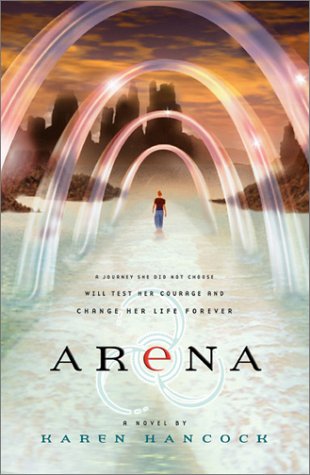
Arena
By Karen Hancock
I usually don't like reading science fiction, simply because all the impossible gadgets and aliens and whatnot tend to throw me off. It's like fantasy with computers, in a sense. But I picked this book up at a Christian store and read the first couple of pages, and I immediately liked how the author characterized the protagonist, Callie. The first few scenes when Callie's friend Meg leads her into a supposedly harmless psychological experiment really make the reader wonder, how will this turn into science fiction? After the first chapter, I was hooked.
At first, I found it hard to believe that the book had been written as a Christian novel. There were aliens, strange devices, monsters, and such things, and no sign of anything related to the cross. But then, when Callie passes through the Gate and into the Inner Realm of the world, that's when I thought, 'So this is where the Jesus theme comes in!'
Elhanu, the great, omnipotent, all-powerful king who created and controls the world they have been sent into, is a benevolent man who wishes for all the humans to make it safely back to earth without succumbing to the temptations of the Watchers and their Fire Curtains (which are basically demonifying steroids that have a suspicious amount of resemblance to Ashera Poles). Immediately, this reminds me of Jesus, and the continuing battle between the forces of Heaven and Hell. Actually, I really appreciated all the subtle hints to various elements of the Bible: for example, the helmets and belts the humans wear are obviously a reference to the armor of God described in the New Testament.
Also, the human struggles Callie goes through, and her ultimate victory, are very encouraging, especially for Christians struggling between self-doubt and faith in Jesus Christ. She gripes with her fear of heights and constantly berates herself for her lack of assertiveness. She almost succumbs to temptations many times, and often observes that she can't do anything on her own. It is through this faulty character that Elhanu works. Her, as well as her companions, each with their own pasts and mistakes, learn to come together, sharing the 'link' that Elhanu offers them as they draw strength from Him and from each other.
And in true Christian sense, the human antagonists of the story, Garth, Rowena, and Morgan, are both maligned and pitied for their failure to see the great powers Elhanu offers. They rely on their own human strenghs and lose themselves within the intoxicating effects of the Fire Curtains, losing their friends as well as their humanity. Though their actions are loathed, the author portrays them as lost souls, whose own stubbornness became their downfall. How many people of this world go down the path of stubbornness and shaky self-reliance today? Here Karen Hancock expresses just a little bit of the regret God feels for these souls everyday.
The ending didn't satisfy me as a reader, though. Pierce loses all of his memories, and although Elhanu promises that they will eventually be restored, the actual moment of recollection is left to the reader's imagination as Hancock finishes off her story. I wanted to see Callie and Pierce meet again. It would have been a very sweet and happy ending.
This book renewed my determination to trust in God no matter what the circumstances, and I hope my fellow brothers and sisters in Christ will give this book a try. And not just Christians--even if you aren't a believer, this story is perfectly accessible.
Thursday, July 12, 2012
The Year of Living Biblically
The Year of Living Biblically: One Man's Quest to Follow the Bible as Literally as Possible
A.J. Jacobs
As the title says, it is book written in a journal form, chronologically recording the author's 1 year of following all of the rules and regulations in the Bible. This ranges from the standard "love thy neighbor" and "you shalt not steal" all the way to the more obscure ones like "you shall hang tassles from your garments" and "sing with a 10-string harp." The author's voice is witty and modern, and he does a good job of drawing contemporary comparisons to the situations he gets into, so that today's secular audience doesn't get turned off by the word "Bible" right away.
I liked that the author was honest about his feelings at the end. He does not convert to Christianity or Judaism, but he claims that he has a higher appreciation towards the things around him, as well as a better idea of God. As a Christian myself, I can't help being a little disappointed that such a drastic (albeit temporary) lifestyle change didn't do more to help him see Jesus, but in the end, it's all in God's time. I can't hate his penmenship--it was fun and funny to read, and I enjoyed discovering what it feels like to actually abide by some of the laws that modern Christians don't pay attention to anymore.
I can tell Jacobs did a lot of research, and devoted a lot of time into visiting experts in the field. I had no idea there were so many religious denominations in existance; my eyes have been opened to a whole new radical side of religion.
One thing I noticed about this book though, was that Jacobs made a lot of references to Biblical things that might be difficult for an audience that is not as familiar with the Bible. Most things, he does a good job of explaining in simple terms, but sometimes, often when he makes a pun or an inside joke, people who have not read the Bible as closely as others might go "huh?" It was hilarious and insightful for me, since I had read the Bible and am already familiar with most of the stories and traditions in the Bible, but maybe Jacobs skimped on explanations a few times.
Other than that, it was a light read. Not very religiously eye-opening or revolutionary, but something casual if you want to know more about the Bible and what it says (though the meanings are interpreted differently everywhere. This book does a good job of at least presenting the material for the audience to judge for themselves).
Thursday, May 31, 2012
The Picture of Dorian Gray
The Picture of Dorian Gray
By Oscar Wilde
Although this is barely more than a short story, Oscar Wilde stuffs it full of themes, meanings, and ideas enough to make my head spin. If I had taken the time to go through the chapters, dissecting the paragraphs one by one, I have a feeling I would have found a lot more being said by Wilde through his characters and his world. Dorian Gray's journey from innocence to depravity in the search for true beauty is uncensored in its grotesque description, yet in a strange sense, I see that same journey being reflected in the real world. Perhaps not as extreme, perhaps even more so, but in any case, Gray is certainly not the only character, fiction or non-fiction, to struggle with and fall prone to the sweet pleasures of distruction
The most prominent element of this book that everybody knows is, of course, Dorian Gray's magical portrait. By an unknown mysterious force, Dorian finds that his portrait suffers the brunt of the passing years and his own depraved lifestyle--while the real Dorian Gray stays fresh, handsome, and young, the portrait ages into a hideous monster that bespeaks of horrible crimes and actions in the real Dorian's life. It is a fantastic idea--having eternal youth while one's own sins are never reflected in our facial expressions, in the dark glimmer in our eyes, in the cruel twist of the mouth (in Oscar Wilde's own words). Dorian Gray, despite his depraved lifestyle, retains the innocent face of his youth, and this is something that almost everyone has wished for at least one time or another. Wars have been fought over eternal youth. Legends have been born to make it real. Futile quests have been embarked in search for that elusive element to make life seemingly complete.
And Dorian Gray gets it.
Oscar Wilde does a fantastic job of passing over the supernatural elements of this event. He does not dwell in a pointless explanation about how this magic works; that isn't the point, after all. He moves on quickly, describing Dorian Gray's reaction--of horror, of ecstacy, of dread, of paranoia, of pride, of disgust. The changes in Dorian's relationship with the portrait are, arguably, the central part of the story, because it is in this relationship that Oscar Wilde explores the contemplation of self. Dorian is reacting to the portrait, but he is also reacting to himself. Every time a new twisted feature is added onto the painting, Dorian either goes into bouts of dispair and self-hatred, and a sort of hyper ecstacy in knowing that nobody but himself will ever see it. The exploration of one's deepest, darkest secrets; the thrills of hiding and the dreads of discovery, all this becomes central in Wilde's narration of human life and relationships.
One of the characters I really want to adress is Lord Henry. He embodies Wilde--he is the prologue of the book, the motivation of Dorian Gray, the anti-conscience that moves the story towards destruction whenever the characters start to ponder the morality of their actions. Unlike Dorian, Lord Henry seems to realize that the true beauty he seeks is beyond reach. He is content to simply think about it, without actually trying to reach it himself. He knows it is impossible, improbable, and unsuited to him. But still, he wishes to glimpse even a bit of it, and he chooses to fulfill this desire by catharsis. Let Dorian and other beautiful creatures strive for ultimate beauty--Lord Henry will watch from the sidelines, a happy audience to their beauty's formation, only stepping on stage to keep them from being sidetracked into "ugly" things like justice or truth.
What is truth? A mere fancy. What is love? A fleeting piece of true art. What is beauty? Nobody knows, but through Dorian Gray's life Lord Henry gets pretty close to finding out. Yet in the end, the beauty they both sought leads to Dorian Gray's destruction, so it seems that Oscar Wilde is denying the merits of beauty. After all, if Dorian's search for beauty ends with a hideous death, then who would want to follow his footsteps. But it may also be noted that the book closes on a description of the lovely portrait--the portrait of Dorian Gray in all his splendor, innocence, and youthful beauty. So was true beauty really reached in the end?
Wilde leaves that for the audience to decide.
Saturday, May 5, 2012
The Woman in White
The Woman in White
by Wilkie Collins
A very long book with a fast-paced narration. There are so many amazing elements to this book that I'm not sure where to start. It can be tedious at times for modern readers who are often exasperated by cliches and stereotypical characterization, but Collins still manages to surprise his audience in the end with his surprising revelation at the end of the book.
The Woman in White is narrated from various points of view by different characters in the story, but the two most important characters are Walter Harthright and Marian Halcombe. When Sir Harthright goes to teach two ladies at Limmeridge House a bit of painting, he unwittingly falls in love with one of them, Miss Laura Fairlie, and is entreated by the other lady Ms. Halcombe to go away from the House before Laura Fairlie's betrothed arrives. Accordingly, Harthright leaves the country in a heartbroken state, completely unaware of the series of unfortunate events soon to befall Laura and Marian. After Laura reluctantly marries Sir Percival Glyde, they find that he is a brutish man who has only married Laura for her money--money which cannot be obtained by him unless Laura is first dead and gone.
What follows is a desperate battle between the two sisters and Sir Percival and his deceptively charming friend Count Fosco...and the final unravelling of the mystery of the woman in white who has been appearing throughout the story the whole time.
The author's narration style completely catches my attention as the events begin to unfold. I often found myself shouting "Noooo!" or "Wait! Stop! You can't!" at the pages of my innocent book, much like the audiences in movie theatres yell at the actress in the horror movie, "DON'T open the door!" Collins achieves this suspense and actively engages the reader by using several different points of view to portray his story. Each time a new character comes in to continue the story where it was left off, the reader is given a more complete picture of what is going on, while the characters are left ignorant of what is to come. In essence, it is dramatic irony in its most fitting genre: mystery.
At the same time, Collins doesn't spiral down into the never-ending pit of sentimentalities and fantastic adventures. The circumstances he weaves together as a series of coincidences, ill-placed luck, and deliberate schemes are realistic--at least, for that period of time. The woman in white, titular to the story, is not some phenomenal superpowered character that she is initially portrayed as. Though she holds the key to the mystery and indeed sets off many of the chains of events that occur, ultimately she is not the one who unlocks the final questions for the reader. Nor are the actions of the antagonists of the story unjustified; as repulsive as Count Fosco is, and as contemptible as Sir Percival appears to be, their motives for their unforgivable actions against the two sisters stem, not from some intricately elaborate desire for evil or revenge, but simple want of money and power. Collins' characters are humane and flawed, making it impossible to stereotype them into completely seperate "love or hate" categories. Reality is emphasized, yet the story stays true to fiction in the excitement it offers.
The one single complaint I had against this book was Laura Fairlie. Oh, Laura Fairlie. The weak-willed and beautiful embodiment of all that is frail, gentle, and pure...and frail. And Frail. Throughout the entire book, Walter Harthright and Marian Halcombe exert their utmost capabilities to protect this charming young creature from harm. Laura's protection is their chief motivation in going against the dangerous Count Fosco; Laura's happiness is their happiness, Laura's smile is their greatest reward, Laura's love gratifies their hearts, etc, etc, &c. I respect Harthright for his daring resourcefulness and bold spirit in challenging his adversaries at their own game. I admire Marian Halcombe for her impeccible memory and judgment, as well as her well-endowed intelligence. Meanwhile, Laura is left behind in the dust. She is nothing more than a victim, and her role in the story does not seem to go beyond the fact that she is the one ultimately wronged by Percival and the Count. The weakness of her character was, in turn, the weakness in the story...at least, that was how I felt.
But as I've said, Harthright and Halcombe are both admirable characters, forging through impossible situations (kindly set up by Count Fosco himself) with nothing but their wits about them (as cheesy as it sounds). Though the book isn't swashbuckling in nature, there is enough action and conflict to keep readers reading late into the night, wishing for the protagonists' victory the whole time.
Monday, March 26, 2012
They Poured Fire on Us From the Sky
They Poured Fire on Us From the Sky
by Benson Deng, Alephonsion Deng, and Benjamin Ajak
I came across this book after I attended a presentation at my school about the Lost Boys of Sudan, where Alephonsion Deng spoke to us personally about his experience as a refugee. His story interested a great many of me and my friends, and we decided to buy the books that they were selling at ten dollars each. I'm very glad I got a chance to read it; there is a story here, a TRUE story, that speaks out to Americans with a very relevant, very present message.
This book is not a moral call to action, nor is it a heart-rendering tale that sends its readers on a guilt trip. The point of this book isn't to blame anyone for what happened to them; it is to let people know it is happening. It is simply a testimony of 3 boys who survived the Sudanese civil war, and witnessed things that no boy should ever have to witness.
Their descriptions of the fire bombs, the wild animals, the starvation, the despair, the callousness of the people around them, the utter loss of hope, are all told frankly and without any sentimental adjectives to try to appeal it to the readers. The narrating voice is simple, spoken in ways that even little children can understand, and talks about things that even adults may find a hard time comprehending. It is ironic, but also a very effective narration.
What I admired most about this book, though, was the fact that these boys were able to still talk, laugh, play, and have fun as boys even in the midst of all this chaos. Yes, these moments were few and far in between, but they were there, portraying their humanity in ways that bellied any sort of tragic and epic adventurous tone they could have adopted.
This is a book whose voice needs to be heard by the world.
Friday, March 16, 2012
Seabiscuit: an American Legend
Seabiscuit: An American Legend
by Laura Hillenbrand
A well-crafted narration, with a lot of hard facts mixed in well with a fast-paced, heart-warming storytelling voice to let the world of America's famed racehorse come alive back from the Great Depression.
Hillenbrand's focus on the three primary men surrounding Seabiscuit's life was a very smart idea; it allowed her to explore the horse from multiple angles--that of Seabiscuit's owner, Seabiscuit's trainer, and Seabiscuit's rider--and better describe the backdrop of the horse races through the biographies of the three. Through the owner, Charles Howard, she describes the upper class society and the dazzling community of America's best men during the 1920s; through the trainer, Tom Smith, Hillenbrand explores the spirit of the old West; and with the horse's rider, Red Pollard, she reveals the behind-the-scenes of the world of jockeys and their desperate competition for the chance to ride the best horse around. Each man's story is explored and commoderated, converging together into Seabiscuit's life as one storyline.
There is never a doubt that Seabiscuit himself is the center of the story. I never got the sense that Pollard, or Smith, or Howard was the main character of the story. It was always Seabiscuit. The facts and figures, the dates and times, the records and competitions, the trainers and riders, all of them revolve around Seabiscuit. I have come to love the horse for his dogged tenacity and lovable personality, as well as his fierce sense of competition, all of which Hillenbrand highlights through an enthusiastic, yet strictly factual tone.
I admit, she lost me a couple of times when all the explanations in the jargon of horseracing came up. It would be hard for anyone who isn't particularly into horseracing to fully understand the astounding amount of detail she puts into this book to make it real. The general storyline can be followed without any problems, but I often got stuck in the nitty-gritty details of her paragraphs. What's a handicap? How long is a length? Questions like these often popped up, halting the flow of an otherwise very good narration. Never have I lamented my lack of knowledge in this area so much. For horseracing junkies, however, this book is it.
The way Hillenbrand brings the readers right into the middle of the racing field made me feel like I was riding right next to Pollard on Seabiscuit, facing the wide-open rail and hearing the thunderous roar of the crowd behind me. These were the parts in the book that departed from the facts and figures, relying purely on the author's imagination to draw out the feeling of being in the midst of a breathtaking horserace. These scenes were executed marvelously; she peppers her paragraphs with short and sweet sentences to blow big impact on her readers.
Her organization of the storyline is well-though out as well. It must not have been easy to bring out so much in this horse's 3 or 4 years of public life, but Hillenbrand does it, even writing it out so as to have a hook in the beginning, a sequence of events leading up to a big climax (the Santa Anita Handicap of 1940), and the anticlimax when she wraps it all up. Also, the theme of the American Dream is impossible to miss in this book--it is so blatantly obvious in all three of the men's lives, as well as in Seabiscuit himself, as well as all the reporters and horse owners and millions of fans that take part in her narration: they are all living out the American Dream of going from underdog to fame and fortune.
She really proves that this horse is worthy of her book's subtitle: an American Legend.
Thursday, February 2, 2012
Vanity Fair
Vanity Fair
by William Makepeace Thackeray
A very long, long, loooong, but fascinating book. I was bored to tears sometimes, but I couldn't stop reading because I just had to know what else the author had to say.
....Which might not make much sense; how is a book boring if it is keeping the reader engaged?
Here lies a piece of literature that truly relies on skill and wit to keep it afloat. The author's voice interested me far more than the actual storyline. The plot itself was simple: following the lives of two radically different women, Amelia Sedley and Rebecca Sharp, the novel is set within the noble life of Europe as the French Revolution draws to a close, zooming in on the everyday happenings of the two heroines and offering paragraph after paragraph of sharp social criticism and satire, enough to satisfy even the most critical soul.
Yes, it was the Thakeray's cynical wit and humorously sharp tongue, sharper than the tongue of Miss Becky Sharp herself, that encouraged me to reach the last page of this book. Thakeray jumps in and out his own novel, oftentimes being an observing bystander akin to a witty journalist that is uncovering all the nitty gritty secrets of high English society, while at other times he is the master of the play that is being acted out, offering apologies to the audience for the often immoral behaviors of the characters being portrayed in his work. His pen travels the continent of Europe, delving into British nobilities and royalties with a graceful flourish, sinking down into the depths of the gypsy nomads of Italy, and never hesitating to explore the middle class citizens of London and Paris who constantly point fingers to both sides of the spectrum of social hierarchy. He follows the gossiping women of the slums, the malicious whispers permeating the upper-class parties, and of course, the bitter yet brilliant commentaries made by Becky Sharp at pointed, opportune times. The author's thoughts stick out from every line.
He also manages to add a bit of a moral ending to the story, despite the overly realistic opinion he seems to hold throughout the events. Amelia, who is the kind-hearted soul never tainted by the unexpected tragedies that befall her, is eventually rewarded for her patience and endurance by being given back everything she lost, and a whole lot more. Becky, on the other hand, who exhibits the ambition of a human being and the cunning of a feline fox in a chicken pen, scrapes together wealth and status but is eventually abandoned by everyone and left with nothing. Thakeray is clearly saying, "they each got what they deserved, though the world treated them unfairly." The residual feelings I had after the end, in which I felt pretty much no sympathy for poor Becky Sharp, convince me that the cynical Thakeray has a ethical agenda in mind.
Overall, the work was worth a study. There were a wealth of social terms that only a Thakeray's contemporaries could begin to interpret, and which made the reading more tedious than necessary at times, but the thought process of the author was easy to follow and offered many foods for thought: do people really look at wealth and social status when they are searching for friends to make? For potential spouses? If so, do the personal qualities of a person not matter in the face of these materialistic values? How much obligation should be placed on family members who find their relatives have been deprived of their money and their reputation? What is true love, a diligent sacrifice or a useless devotion?
Such questions, and a whole lot more, can be found among the stalls of the vanity fair.
Subscribe to:
Posts (Atom)