Monday, March 11, 2013

The Lord of the Rings

The Lord of the Rings: The Fellowship of the Ring
by J. R. R. Tolkien
 
I have never watched the movies and this was my first time attempting the trilogy, and I must say it was not exactly how I expected it to be. Perhaps because I've heard so many conflicting opinions about the series, but it wasn't nearly as masterful as I was looking forward to discovering.
 
I did appreciate the quiet and quintessential beginning that takes place in the Shire. The life of the hobbits before their fantastic journey, the everyday conflicts and family problems, birthday party celebrations, the locality of the setting...it all provided a wonderful contrast with the grand scale of the adventures that would dominate the rest of the book. In fact, arguably, the beginning was my favorite part. There is a sense of excitement that runs beneath the currents of the opening scenes in the Shire--sort of an expectation for what we know will come with the arrival of Gandalf--that makes the reader flutter with yet-unnamed emotions.
 
However, when the actual adventure gets underway, I felt that some of those forshadowing elements were lost. Can't be helped, I suppose...the story must go on. But the high tension of the narrative seemed to slacken as the hobbits ventured further and further away from the Shire, instead of rising, as a proper adventure story should. The more obvious reason for the lack of heart-throbbing excitement could probably be attributed to the sheer amount of time the author devotes to describing the continent. I generally have no problems with long description passages that detail the hills, the trees, the rivers, the sky, the roads, the birds, etc, etc...but when Tolkien begins to attribute proper names to each and every single one of these elements, regardless of whether or not they can be pronounced by the English tongue, it started to get just a bit tedious for me.
 
Of course, the adventurous story of Frodo and his company is very enjoyable. There is a bit of everything that makes a good fantasy novel, and each character is appropriately fantastic while at the same time grounded in faults that makes everyone human. (That...sounded very cheesy and bookish just now, but it's true. What can I say.) But it becomes a problem when the only character you fully empathize with is Frodo. Every other character has some sort of backdrop--a history, a motivation, various circumstances that shape their past and will shape their future decisions. But literally, there is almost no explanation of any of this. Gandalf remains the mysterious wizard, Aragorn remains the mysterious Strider, Boromir remains the mysterious (i.e. suspicious) dude/person/guy, Gilmi and Legolas both also mysterious dwarf and elf, respectively. In a way, Merry and Pippin also remain a mystery--why are they so loyal and eager to follow Frodo into danger? What is their past relationship with the protagonist? Everything remains somewhat outlined, but glossed and skipped over in the course of the story. Therefore it's harder to understand where each person is coming from. The group doesn't come together cohesively. I mean, it's understandable that the characters within the story wouldn't just become chummy right away, but as an omniscient narrator, it wouldn't hurt Tolkien to give us readers a little bit of an inside scoop.
 
I have a sneaking suspicion that a lot of my criticisms will be cleared away once I actually read through the entire trilogy. Nevertheless, as a single standing book, The Fellowship of the Ring left a lot to be desired. Or maybe I was just a little too lost between Rivendell and Mordor and couldn't figure out my way as well as Aragorn could. In any case, I think I'll wait a little before attempting to tackle the sister novels of this work.

Friday, February 22, 2013

Little Women

Little Women
by Louisa May Alcott
 
An episodic sort of story, almost like a fairy tale, with a moral to be learned on every page. When I first picked up this book, I confess that I thought of it as more of a children's book. But it struck me as a surprisingly pleasant narrative, enjoyable for any age from 8 to 80. Actually, as any good book, it's easy to read, but can be better enjoyed by readers who have a bit of experience under their belt, because the depiction of the lives of the members of the March family is better understood by adults. Yes, the story is simple, but it is also a message of how to live life. There may be some feminists out there who would like to burn this book out of existance, but I thought it was a picturesque telling of the moral values of Alcott's time.
 
Plot is deceptively simple: life and times of the four March sisters. But this sentene isn't enough to really encompass the whole of it. These are four different lives. The happenings in the everyday life isn't one that can easily covered in the span of one novel. Of course, there's a great deal of interweaving between the stories of the four girls, seeing as they all live under the same roof, but there's still a degree of separation that ensures that none of them take center stage. The quite little details that piece together into the larger story--these elements make the novel a far more pleasant read than if it was just big drama and Hollywood action.
 
Admittedly, the characters tend to come off as a little too upright, too eager to fix their mistakes, even a little unrealistic in their constant strivings to be good. I mean, as humans, we all make mistakes, even Beth March. The faulty human side is a little lacking here, because even when the sisters do make some mistake, it is quickly and easily mended before any serious damage is done. Yet at the same time that this takes away from the reality, it's also a wonderful breath of fresh air. As a reader, I thought it a nice change that I didn't have to keep on the edge of my seat the whole time screaming "don't do it! Don't do it!!! DON'T....great, you've gone and done it."
 
No, none of that. I could rest easy in the confidence that any and all mess-ups would be mended and done away with within the same chapter. Is it potentially dull? Possibly? Do I like Meg better than I do Frodo Baggins from Lord of the Rings? Oh, Yes.
 
The story progression flowed quietly from one event to the next, seamlessly connecting the lives of the characters into a larger picture of everyday life. There wasn't really any major climax that I could detect; rather, there were multiple major "happenings" that kept the story from sinking into the mires of mundane mugginess.
 
One thing I noticed was the varying personalities of the sisters. Of course, the book is known for having four protagonists, but I thought Alcott did a remarkable job of distinguishing the sisters from each other without ever favoring one sister above the rest. Each sister takes up an appropriate amount of space within the narrative, and if Jo seems to have more dialogue than Beth, than I say it's due to the nature of their characters rather than a bias on the narrator's part. In fact, it almost seems like the author is allowing the reader to choose his or her own favorite character. Which sister can you most connect with? Which one rings true to your heart? I had a great time following up on Jo's adventures, because the 21st century dotes on tomboys and the strong-willed character. But I also liked Amy, she was just so cute.
 
And of course, you can't forget the sage quotables of Mother March--the quotes that every good person highlights and less than half of them can actually carry out. If only the things she advises were that easy to accomplish...
 
Quick and light, it's a story I enjoyed with the heart of a child sitting in the lap of her mother while she tells a good bedtime story.

Saturday, December 8, 2012

Nerds

Nerds: Who They Are and Why We Need More of Them
by David Anderegg, Ph.D.
 
This title caught my eye at a booksale I went to. It's the first non-fiction essay I've read in a while, but I have to say that the topic was what drew me to pick it up. A book about nerds? That sounded fascinating.
 
The writer introduces a series of questions: exactly what sort of qualities constitutes a nerd? What's the difference between a nerd and a geek? How prevalent is the nerd stereotype in our American culture? Is the stereotype of "nerdiness" affecting the children of America in a negative way?
 
The author's voice is approachable and reader-friendly. Despite the social psychology aspects of this topic, he rarely uses professional jargons or long, winded-out sentences and makes sure to define and reiterate any potentially confusing ideas. So if I didn't understand something the first time I read it, I move on; nine times out of ten, he repeats it in a slightly different sentence format that helps get the point across.
 
This book raised a lot of inner questions for me. My first reaction after completing the first chapter was to ask myself: is the nerd persecution of elementary and middle schools of America really as bad as he makes it out to be? Because when reading this book, it's pretty bad. Kids are being driven to depression, self-denial, loss of identity, and all sorts of social problems because they are being labelled as "nerds" by other kids. The author also points out some correlations between the decline of interest in math and science of middle schoolers, and the increasing phenomenon of nerdism among those students. Though he refrains from declaring the thesis outright, there is an implication here that essentially, children's desires not to be labelled as a nerd contribute to a decrease of interest in maths and sciences...because maths and sciences are nerdy.
 
I can't say anything as a representative of any pool of nerds, but as a studious type of student myself, who posts book reviews on my very own blog in my spare time, I'd say that I may also fall into the nerd category. And the persecution was never as bad as how this book describes it. Perhaps the majority of the children he interviewed/sampled for his research happened to be kids suffering problems as a nerd. Perhaps he didn't get a lot of kids coming into his office to declare: "I'm a nerd and I'm proud of it!" But in any case, I found myself wondering if this book is just slightly exaggerated.
 
But otherwise, it's an intellectual read, worth the several days I spent reading the results of Dr. Anderegg's social studies. I especially liked the advice to parents that he included in his conclusion. No matter what I may or may not think about nerd stereotypes after reading this book, it still gives some practical tips in how to help my future kids deal with such social problems, should the need arise. Better safe than sorry.


Thursday, November 29, 2012

The Jungle

The Jungle
by Upton Sinclair
 
A bit of chugging required. Before I picked up this book, I already had a basic knowledge of the background circumstances. Mainly, the political graft and corruption that ran rampant in the United States in the early 20th century, as well as the severely harsh conditions imposed on the immigrants coming in through Ellis Island. It helped me have the rght perspective in mind when I read through some of the drier parts of the narration: the overly detailed accounts of the butchering processes in factories, the elaborate monologues by socialists, the overbearing description of the protagonist's utterly bereft situation. All of these I interpreted as supporting statements for the author's argument about immigrant workers in America, rather than as divergeances from the main storyline. Indeed, in Upton Sinclair's novel, the plot is hardly central. If somebody picks up this book expecting a good story and some sympathetic characters, there is not much to be gleaned. But if every element, every paragraph is taken to be a survey of the lives of the oppressed in the 20th century, then this book can be fairly enlightening.
 
The first chapter starts off at a wedding. When I read the opening paragraph depicting the merry celebrations of a newlywed Lithuanian couple, I confess: I did a double take, made sure I had the right book in my hands, and read the paragraph twice more to ensure that indeed--it was a jolly wedding. It is only when Jurgis, the groom, suggests that his bride Ona take the next day off from work that the theme of the book becomes clearer. Ona protests violently, despite it being their honeymoon. Her reason is that if she takes the day off, they "shall be ruined."
 
This first glimpse at the darker side of the narration leads to an explanation of how this family ended up at a wedding in America, and at first, the author's voice, and the characters' attitudes, are deceptively upbeat. Everything is flowers and meadows, dreams of hope and riches and freedom, awestruck wonder at the technology of the US meat-packing industries.
 
But time moves forward. The family buys a house. They get jobs. They settle down to earn a living. And they find themselves caught up in the destructive competition among workingmen. If one doesn't work well enough, they find themselves out on the streets, replaced at the job by someone else willing to work for half the pay. The jobs are dangerous, unsanitary, and monotonous. It becomes increasingly harder for the family to make ends meet. It is at this point in the story that Jurgis and Ona get married. Their attempt to hang on to their traditions, and indeed, humanity itself, glitters as the last glimpse of their happiness, before they are plunged into debt, poverty, oppression, and misery.
 
I thought this to be a clever set-up on the author's part. Behind the merrymakings of the first chapter, there lies a deep cavern of human misery into which polite society dares not look. Most Americans of Sinclair's time must have imagined the lives of immigrants to be something like that wedding--though they may not have the best of circumstances, they make do with what they have and achieve happiness one way or another. But in the rest of book, Sinclair clearly denies this illusion. Immigrants are not even given the chance that Lady Liberty stands for. As the book puts it, they sow so that others may reap. They die without ever gleaning the fruits of their labor.
 
Another thing I noted in the course of this book was the way Sinclair managed to portray all the different facets of American society through just one character. Jurgis, who starts out as a dreaming young man moving to America, lives through a great many changes in his lives, each reflecting an aspect of the US that hadn't been visible before. First, he toils as a working man among the machines, slowly wasting away under the pressures of family burdens and low wages. At one point, he finds himself being paid to vote for a political candidate of his district, showing the readers a glimpse of the lowest portion of the political corruption system. Then he is unjustly thrown in jail and meets the criminals of America--an even darker side of American society than before. When he emerges, he goes on to wander the country as a "hobo," and through a series of events, becomes involved in the heart of the political manipulations going on in Chicago. In essence, Jurgis travels from being politically manipulated to becoming a political manipulator. Thus, the reader has a chance to take a look at the process directly, rather than simply wondering at its inner workings the whole time.
 
But Jurgis' period of political involvement doesn't last too long, and he finally ends up among the Socialists. During this time period, most Americans scoffed at the idea of socialism--it seemed unnecessary when democracy ruled DC. But Jurgis' interpretation of Socialism is startling. To him, socialism is the only doctrine that offers a solid, practical way to escape the endless cycle of misery he has been condemned to. Everything in this book, portrayed from the point of view of the lowest class of men, becomes inverted. The meat-packing industries that provide food to so many homes are now the lowest, dirties, scum-of-the-earth who suck the life and will out of the poor to buy diamond rings for the rich. Unlike the American ideal of a settled home and a family, Jurgis prefers to wander alone, unburdened by the responsibility of blood relatives to take care of. Democracy is powerless; it is socialism that brings renewed hope. All of these would have contradicted typical American beliefs at the time, yet Sinclair portrays these views so convincingly that even president Roosevelt felt the need to act upon it, if somewhat reluctantly.
 
Mostly, what strikes me about this book is the imploring voice of the narrator. It felt a bit over-the-top, and sometimes downright exaggerated, but overall there is a sense of urgency and disgust at the state of conditions that calls for the reader to think more deeply about the truth of these statements. It isn't so much about the disgusting tubs of lard and fat being processed through contaminated tubs. This book reveals the absence of democracy in the land of the free, as seen through the eyes of people who felt the repurcussions the most.


Tuesday, October 23, 2012

Kite Runner

Kite Runner
by Khaled Hosseini
 
A vivid read. I actually meant to read this a lot earlier, but somehow or another never got around to it until last week. This story, of a skewed friendship and a haunting past, that ultimately circles back onto itself, served as a great mirror of the human faults, as well as the human beauty. It raised a lot of important and poignant questions in my mind: When courage fails and fear overtakes you, what should one do? When faced with the decision of personal safety or justice for others, what should one do? Can any one person be blamed for anything bad that happens in life? I loved the way this book left me to ponder these, and so many more important life questions as I flipped past the last page.
 
The main character Amir is not lovable. He does nothing to beholden himself to his readers; rather, he comes off as cowardly and whiny, always trying to justify his selfishness and wrongdoings. At the same time, though, the reader must empathize with him. Empathy is demanded. Not just because of his thirst for a father's love, as universal as it is. I connected with Amir in his descriptions, his voice. The brilliant flashes of his childhood days, colored gold in the good parts and bloodstained red in the bad, are similar to the childhood memories that we often have. We don't remember the good old days as an unbroken roll of film. Like Amir, our childhood pervades our lives in short bursts of vivid detail. Ordinary objects call to mind something that happened in the past, and more often than not, it is the little, unimportant memories that we recall, rather than the big grand ones. So it is with Amir, and I loved that--as much as he shuts out Hazzan and Kabul from his life, the way he talks, the way he describes things, the way every other paragraph always alludes back to his Hazara friend, is beautiful in its humanity. And in his humanity, we find a fellow human being to connect with.
 
Hazzan embodied perfection, I felt. Rather than being a down-to-earth, real-life person, this other boy felt more like a foil for Amir himself. Everything Hazzan says or does provides a detail with which we compare Amir. Hazzan can skip stones better than Amir. He is the nicer one. The braver one. The one who is favored by Baba. The one who can beat Amir in cards and can solve all the riddles Amir gives him. The one who can run a kite better than any other kid in the neighborhood. These qualities are downgraded by Amir, who emphasizes Hazzan's lowly status, his hated heritage, and the fact that Hazzan will always obey Amir's will, no matter what. Amir tries his best to make sure Hazzan never becomes the better of the two. Amir is full of flaws, and the irony of Amir being the priveleged boy while he seems inferior is not lost upon the reader. This contrast between the two boys is a natural foreshadowing for the tragedy that follows.
 
What I'm still wondering is, how did Hazzan know? How did he know that Amir knew what happened? This is the only unexplained part in the book that I thought worth mentioning. It could be that the author left that answer blank on purpose, to really show the void left behind by Hazzan's death. In Hazzan's gruesome end, this question will remain unanswered forever. Or perhaps Hazzan knew, because just as Amir saw the resignation in Hazzan's eyes, perhaps the servant boy saw the fear in Amir's.
 
I want to read Hosseini's other work, A Thousand Splendid Suns, as soon as I have the opportunity. There is much to be gleaned from his writing. The growth of the characters is heartening to follow, and the slow process of redemption is clearly ongoing as the book comes to a close. While it does not end on a 'happily ever after' note, it is definitely not a tragedy. It is a book that endlessly emphasizes hope: "There is a way to be good again."

Friday, September 28, 2012

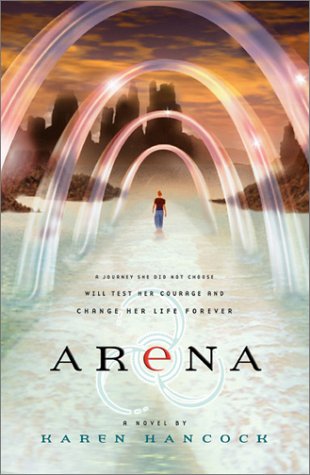
Arena


Arena
By Karen Hancock
 
I usually don't like reading science fiction, simply because all the impossible gadgets and aliens and whatnot tend to throw me off. It's like fantasy with computers, in a sense. But I picked this book up at a Christian store and read the first couple of pages, and I immediately liked how the author characterized the protagonist, Callie. The first few scenes when Callie's friend Meg leads her into a supposedly harmless psychological experiment really make the reader wonder, how will this turn into science fiction? After the first chapter, I was hooked.
 
At first, I found it hard to believe that the book had been written as a Christian novel. There were aliens, strange devices, monsters, and such things, and no sign of anything related to the cross. But then, when Callie passes through the Gate and into the Inner Realm of the world, that's when I thought, 'So this is where the Jesus theme comes in!'
 
Elhanu, the great, omnipotent, all-powerful king who created and controls the world they have been sent into, is a benevolent man who wishes for all the humans to make it safely back to earth without succumbing to the temptations of the Watchers and their Fire Curtains (which are basically demonifying steroids that have a suspicious amount of resemblance to Ashera Poles). Immediately, this reminds me of Jesus, and the continuing battle between the forces of Heaven and Hell. Actually, I really appreciated all the subtle hints to various elements of the Bible: for example, the helmets and belts the humans wear are obviously a reference to the armor of God described in the New Testament.
 
Also, the human struggles Callie goes through, and her ultimate victory, are very encouraging, especially for Christians struggling between self-doubt and faith in Jesus Christ. She gripes with her fear of heights and constantly berates herself for her lack of assertiveness. She almost succumbs to temptations many times, and often observes that she can't do anything on her own. It is through this faulty character that Elhanu works. Her, as well as her companions, each with their own pasts and mistakes, learn to come together, sharing the 'link' that Elhanu offers them as they draw strength from Him and from each other.
 
And in true Christian sense, the human antagonists of the story, Garth, Rowena, and Morgan, are both maligned and pitied for their failure to see the great powers Elhanu offers. They rely on their own human strenghs and lose themselves within the intoxicating effects of the Fire Curtains, losing their friends as well as their humanity. Though their actions are loathed, the author portrays them as lost souls, whose own stubbornness became their downfall. How many people of this world go down the path of stubbornness and shaky self-reliance today? Here Karen Hancock expresses just a little bit of the regret God feels for these souls everyday.
 
The ending didn't satisfy me as a reader, though. Pierce loses all of his memories, and although Elhanu promises that they will eventually be restored, the actual moment of recollection is left to the reader's imagination as Hancock finishes off her story. I wanted to see Callie and Pierce meet again. It would have been a very sweet and happy ending.
 
This book renewed my determination to trust in God no matter what the circumstances, and I hope my fellow brothers and sisters in Christ will give this book a try. And not just Christians--even if you aren't a believer, this story is perfectly accessible.


Thursday, July 12, 2012

The Year of Living Biblically

The Year of Living Biblically: One Man's Quest to Follow the Bible as Literally as Possible
A.J. Jacobs

As the title says, it is book written in a journal form, chronologically recording the author's 1 year of following all of the rules and regulations in the Bible. This ranges from the standard "love thy neighbor" and "you shalt not steal" all the way to the more obscure ones like "you shall hang tassles from your garments" and "sing with a 10-string harp." The author's voice is witty and modern, and he does a good job of drawing contemporary comparisons to the situations he gets into, so that today's secular audience doesn't get turned off by the word "Bible" right away.

I liked that the author was honest about his feelings at the end. He does not convert to Christianity or Judaism, but he claims that he has a higher appreciation towards the things around him, as well as a better idea of God. As a Christian myself, I can't help being a little disappointed that such a drastic (albeit temporary) lifestyle change didn't do more to help him see Jesus, but in the end, it's all in God's time. I can't hate his penmenship--it was fun and funny to read, and I enjoyed discovering what it feels like to actually abide by some of the laws that modern Christians don't pay attention to anymore.

I can tell Jacobs did a lot of research, and devoted a lot of time into visiting experts in the field. I had no idea there were so many religious denominations in existance; my eyes have been opened to a whole new radical side of religion.

One thing I noticed about this book though, was that Jacobs made a lot of references to Biblical things that might be difficult for an audience that is not as familiar with the Bible. Most things, he does a good job of explaining in simple terms, but sometimes, often when he makes a pun or an inside joke, people who have not read the Bible as closely as others might go "huh?" It was hilarious and insightful for me, since I had read the Bible and am already familiar with most of the stories and traditions in the Bible, but maybe Jacobs skimped on explanations a few times.

Other than that, it was a light read. Not very religiously eye-opening or revolutionary, but something casual if you want to know more about the Bible and what it says (though the meanings are interpreted differently everywhere. This book does a good job of at least presenting the material for the audience to judge for themselves).